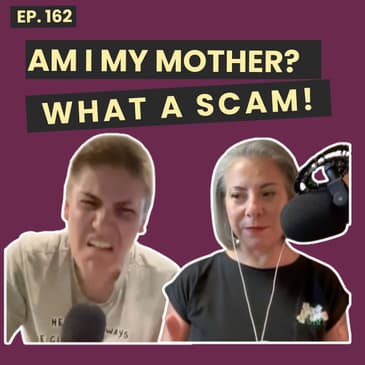
Rosie and Roula tackle a saying that has followed women around the world: “If you want to know how your wife will look later, look at her mum.” Roula explains she heard this sexist expression throughout her childhood in Lebanon and even from Europeans, while no one tells men to check their future father‑in‑law. She and Rosie discuss how ageing stereotypes and gender roles create pressure on women to stay youthful, hide their birthdays and buy different creams for every body part. Rosie notes that society links a woman’s worth to wrinkle‑free skin, whereas men rarely face such scrutiny. The conversation drifts into personal stories about how often children resemble their parents and admits that some older fathers and sons age gracefully too. Roula then calls out the anti‑aging industry, revealing she uses the same vitamin‑E body cream on her face and body because “it’s all marketing.” Rosie agrees that beauty companies prey on women’s insecurities and encourages listeners to question why we chase youth. Throughout the episode, the hosts laugh, rant and invite listeners to reject outdated sayings and love themselves at every age.
Highlights and Timestamps
- Opening hook (00:01) – Roula introduces the “six‑minute episode” challenge and tees up a controversial saying about women’s looks.
- Sexist saying & gender roles (00:25–01:05) – Roula shares the Middle Eastern saying and questions why men aren’t judged by their fathers’ looks.
- Ageing stereotypes & sexism (01:05–02:30) – Rosie admits society pressures women to stay youthful and hide their age; they both critique the obsession with wrinkles.
- Family resemblance & judgement (02:30–03:34) – Roula recalls Lebanese women judging daughters by their mothers’ looks and notes many men look like their fathers.
- Exposing the anti‑aging industry (03:55–05:45) – Roula reveals she uses one vitamin‑E cream everywhere and calls out companies for labelling identical products differently; Rosie agrees it’s just marketing.
- Closing thoughts (05:45–06:00) – The hosts encourage listeners to question beauty standards and love themselves as they age, promising more mini‑episodes.
Call to Action
If you’ve ever been judged by a sexist saying or felt pressured by the anti‑aging industry, share your story in the comments or leave us a review. Subscribe to The Rosie & Roula Show and join our conversation on ageing gracefullyand challenging gender stereotypes.
(sexist sayings about wives, ageing stereotypes, gender roles, Middle Eastern culture, anti‑aging industry, skin‑care marketing, family resemblance, self‑acceptance)
--------------------
- ☕️ Buy us a coffee!
- 🎙️ Send us a voice message
- 🛍️ Buy some Rosie and Roula merch!
--------------------
- ⭐️ Leave us a review
- ▶️ Follow us on Instagram and TikTok
- 🎞️ Subscribe to our YouTube channel
--------------------
- 🎧 Check out Roula's podcast
- 🎧 Check out Rosie's podcast
TRANSCRIPT
Roula (00:00)
Head record.
Rosie (00:00)
counting down.
What do you got for me, Rula?
Roula (00:04)
Rosie, this is our second episode in the test of under the six minutes. Yeah, okay.
Rosie (00:10)
Yeah, first one we
did, yeah.
Roula (00:25)
We have the saying in the Middle East. And I heard it also from someone here, European person. And I was like, this saying, everyone has it and it's so wrong. And I want to understand why. Do you have the saying in Australia? They say to the guy, if you want to know how your wife will look later, you should look at her mom.
Rosie (00:36)
Ooh.
Okay.
yeah, what the hell?
Roula (00:50)
But they never tell me or anyone if you want to see how your man will look like later look at his dad. Why is it important to know if your wife will look good later or bad? I don't know what they mean with it. But you don't say it to the guys.
Rosie (01:02)
Ugh.
think aging is very much centered around women and it's important to look youthful and women are raised to be self-conscious of wrinkles or blemishes and you get to a certain age and you stop telling people how old you are or every birthday you get upset because you're getting older. That's a really common thing for women, am I? ⁓
Am I gendering this too much or do you think it's more of an issue for women than men?
Roula (01:42)
I haven't heard it said to anyone else about women.
Rosie (01:46)
What? Right.
And you're right, it is weird.
Roula (01:49)
And
I've been, yeah, it's like, you know, I remember reading in the society, I grew up, it is so freaking sexist, unbelievable. Middle Eastern society is so sexist, it hurts my, the cells in my body hurts from that. So I really remember.
Rosie (02:08)
Ha ha!
Roula (02:13)
in Lebanon, how women would say this so often and they observe it. And even if there is no intention of any relationship, they judge how girls, if they look like their mom and if their moms are not looking like top models, who looks like a freaking top model anyway? This is in their head, in their image. So, so, yes, it's it's surprisingly, it's set to women, but not to men, though, though.
Rosie (02:43)
Hmm.
Roula (02:43)
When
I was on vacation and I've seen so many ⁓ families together, moms dead with their grandparents, it really got my attention how many guys look like their dads.
Of course, a lot of women look like their moms. mean, my daughters, look my youngest, my middle daughter. She's a copy of me, but getting older. So I really noticed how many men looks like their dads. And I also noticed that's me. I'm picky, judgmental and everything you want to hear. I kind of liked looking at good looking older men and their good looking sons.
Rosie (03:02)
Mm-mm.
Mmm.
Roula (03:28)
So there is some kind of reality to it.
Rosie (03:29)
⁓ god!
Roula (03:34)
Yeah
Rosie (03:34)
just
it just feels very weird. I think it's weird. We're too obsessed with how we look and the fact that it is a saying that has become accepted is just wrong.
Shouldn't you marry your wife because you love them? Not, ⁓ I'm obsessed of how they're gonna look when they're older. Let's check out their mum.
Roula (03:55)
Yep.
Yeah, you know, in the general and the people around me, my generation, I haven't heard them saying that unless as a joke. So I have to give the credit that probably the older generation think this way. ⁓ OK, we still have two minutes. I want to touch on the anti aging. You know what the body cream.
Rosie (04:05)
I just found it with
Yeah, true.
okay, all right, shit. You wanna chuck anti-aging
in there for the last two minutes, less, okay.
Roula (04:32)
Yes, yes. So my body cream, I put it on my face. I do not buy cream for my face, cream for my body, whatever. Whatever cream that has vitamin E or something good that is rich, I put it all over me. I do not separate because I think it's the same cream. They put it in different containers and label it differently. So they make us buy more. Maybe they tweak it.
Rosie (04:37)
Hmm.
It's all marketing, isn't it?
They're preying on women's insecurities.
Roula (05:08)
Yeah. ⁓ Do you use day cream, anti-aging? What do you, well, you should not use anti-aging. You're in your thirties.
Rosie (05:19)
Yeah, I don't use anti-aging cream. ⁓ Sometimes I use cream, sometimes I don't. just, I can't be bothered. But I know for some people it's a really important part of their routine and it feels good. And that's a good thing, caring about your appearance. Like, hey, I encourage that, but buying into this marketing and being obsessed with how old you look, I'm not cool with that.
Roula (05:44)
Okay, okay, very quickly, I read in the news about the sunscreen scandal in the Australia newspaper, and it sounds like the most expensive Australian sunscreen don't apply. A bit longer. I'm not complying with the sunscreen. Time's up, time's up. But you know, listeners, what I mean. Go check out the article. Thank you for listening. Bye.
Rosie (05:59)
Time's