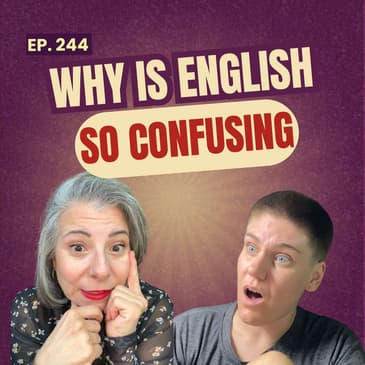
In this fun, honest, and unexpectedly deep episode, Rosie & Roula dive into a listener question that sparks a fascinating conversation about English accents, spelling differences, slang, and global communication.
After receiving a voice message from Roula’s son, the hosts explore why English sounds so different across countries like the UK, the US, and Australia—and why that can be confusing (and sometimes frustrating!).
They unpack:
- Why British vs American vs Australian English use different spelling (colour vs color, organise vs organize)
- How accents and pronunciation impact understanding—even between native speakers
- The surprising differences in everyday words (boot vs trunk, bin vs trash can, thong vs G-string 👀)
- The challenges faced by non-native English speakers navigating mixed spelling and vocabulary
- Why exposure to media (especially American TV) shapes how we think English “should” sound
- How accents shift depending on environment, culture, and even who you're speaking to
- A personal story about identity, language, and how dialect connects to memory and belonging
This episode is equal parts hilarious and insightful, with real talk about language bias, communication struggles, and why there’s no “right” way to speak English—just different ways.
✨ Whether you're a native speaker or learning English, this episode will change how you think about language forever.
--------------------
- ☕️ Buy us a coffee!
- 🎙️ Send us a voice message
- 🛍️ Buy some Rosie and Roula merch!
--------------------
- ⭐️ Leave us a review
- ▶️ Follow us on Instagram and TikTok
- 🎞️ Subscribe to our YouTube channel
--------------------
- 🎧 Check out Roula's podcast
- 🎧 Check out Rosie's podcast
TRANSCRIPT
Rosie (00:11)
Listeners, I mentioned at the end of the last episode, if you didn't hear it, that's because you clicked out early, how dare you. But I mentioned at the end of the last episode that Roula's son sent us in a voice message. So I'm very excited because Roula didn't know that he did
So we're going to see if I can figure out the technology ⁓ so Roula can hear it while we're recording. Let's see how I go.
Hey, Rosie Roula I have an idea for a podcast episode. You know that like in America, United Kingdom and Australia, they say like they have like a different accent and they say different stuff and write different? Can you guys make an episode about that, please? Thanks.
Was the cat on the recording then or is that that's the cat now? On the recording, the cat, the cat contributed to this recording. OK, I have thoughts on this. So I don't know. Are you do you want to start?
Roula (01:02)
That's the cat! Yes! No, no, on the recording!
I have no idea. So my son is asking, what?
Rosie (01:18)
You
don't know he's asking, do you? Do you know what he's asking?
Roula (01:22)
He drank and the whole water fell. Did you notice or not? It looked like you spilled water. I understand his question. He wanted to know why in the English language, different countries have different accents, different way of speaking.
Rosie (01:25)
No it didn't! It didn't! There's no water! Did it? I didn't. Okay.
and spilling.
Roula (01:42)
and spelling. I say this podcast is not for children. there he is. Yeah, come over. I'm going to I'm going to have him come over for a second. So, yeah, I said this podcast is not for children, but please, family, feel free to listen to this with your child and let's have him physically come to the stage.
Rosie (01:50)
Okay.
Roula (02:03)
and say hi. Hi. We're going to answer your question now. Yay. I came just in time. I'm going to give him the earphone.
Rosie (02:04)
It's Liam, hi. I'm loving your new hair Liam. I haven't seen you in a while.
Okay, I'm loving your new hairstyle. I haven't seen you in a while. It's changed. I like it. Very cool. We're just about to answer your question that you sent in. Do you remember about accents? Yeah. Yeah.
Roula (02:16)
Thanks.
Yeah? Yes, I do.
Alright, darling. Thank you for sending the question. Just hands.
Rosie (02:28)
Just kidding! Don't top your mum in!
Roula (02:31)
Watch out, don't fall! Alright. It's a bit messy here. They don't need to know. It's a bit messy here.
Here it looks perfect, don't look around!
Thanks, Neil.
New guests acquired!
Rosie (02:45)
You guessed it, quiet!
Roula (02:47)
He's such a funny guy. yes, I don't know. You said you have thoughts on the question. Bring it on.
Rosie (02:50)
You don't know. I do have thoughts because it drives me
bonkers. So in Australia, we use British spelling, what they use in the UK. So a good example of that. What's a common one? Colour. Yes. Okay. S is it. So for example, if we said specialise in Australia, in the UK, it's ISE on the end, but in the US, only the US can I just add.
Roula (03:05)
The S is Zed?
Rosie (03:17)
I Z E. And my goodness, there's things like color in the U S C O L O R in Australia or UK, other countries C O L O U R. So that's one thing. And that yes, there's accents. That's a big thing. But something I want to add to Liam's comments is the words we use can be different. So in Australia, thongs
mean flip-flops or sandals. In the UK, a thong is a G string.
Roula (03:46)
Yeah, and in America it's a G string. It's not a song, I think.
Rosie (03:47)
and in a... yeah.
What? Yeah. Like, so how interesting is
that? Yeah. I'm not sure in America, probably. And in Australia, and I think the U S pants mean trousers, but in the UK pants means underwear and I've lived in the UK. So I've got experience with it, but it's all English. It's considered the same language, but totally different meaning. Totally different.
Roula (04:02)
Yeah!
Okay,
pavement. Is it sidewalk in Australia or is it pavement?
Rosie (04:13)
Yes.
footpath. See, this is another word. Walking down the footpath. I wouldn't say, no, rubbish bin or bin. Yeah. Like I know what that word means, but we use a different word. Yeah. I don't really use it. And if someone says it, I'm like, that's very American. Like if they're an Australian saying it. But what really pisses me off Roula is that
Roula (04:18)
Foot bath.
⁓ Okay, trashcan.
Rubbish bin!
But you never use it.
Rosie (04:40)
And I'm going to be judged so hard for this because I'm generalizing, but I'm leaning into it online. When I see posts from an Australian source and they're talking about something. So what's an example we call, you know, the back of your car and you have the, the lid thing. We call it a boot. don't know what you were taught when you learned English, but in the U S it's called a trunk. We do not call it that here.
Roula (05:00)
Yeah.
Rosie (05:02)
So you see posts where it might refer to it as a boot and all these people in the car. It's all what the fuck is a boot. Oh my God. I don't know what that means. All these other like rubbish bin can windscreen wipers was one of them. I can't even remember what word they used. Bonnet over here. That's the front of the car. What's the word the US uses? It's something else.
Roula (05:25)
Motor cap?
No.
Rosie (05:26)
See, I've forgotten.
Roula (05:27)
I don't know
Rosie (05:28)
I have no way to see I've forgotten, but
even you know, English is not your native or your first language. Sorry. But you are aware that there's different words that mean the same thing. Right. And it's not your first language. I, to a certain extent, of course, you can't know everything. Neither can I. English is my first language. I am aware that there are different words, meaning the same thing. There are ones I prefer to use, but if I hear someone say a different word, I know what they mean.
Roula (05:40)
to a certain extent.
Rosie (05:54)
But it just seems American people in the comments are just outraged and couldn't possibly believe that there are other people in the world that use different words. And I think...
What like you're so small minded. And then I was confronted not by anyone else, but by myself. And I went, maybe, maybe I should be less harsh because I realized most television, like that are in English is from the United States. And I thought, how are people in the U S going to be exposed?
Roula (06:11)
Self-reflection, I can't be.
Rosie (06:25)
how we speak in Australia because there's hardly any Australian TV shows or movies that they would see. There's more British things they would see though so like come on I just I find it so weird that people think there is one way of saying things. I don't expect people to know all the words but don't be like my god it's not wrong that's right right it's just different.
Roula (06:43)
It's not wrong. It's not outrageous if someone use another word.
Rosie (06:49)
And yeah, inside it pisses me off when someone spells the American way, but you know what? I suck it up unless it's okay. As a teacher and I'm teaching in Australia, I would correct it because that's the generally accepted way to spell. However, there would be a conversation that actually, if you were in the U S that's accepted spelling. So you're not wrong, but the way we spell here, like, like you said, it's not wrong.
Roula (07:11)
Yeah. Let's say you're right.
You're at school and you write the word organization with an S rather than a Z. ⁓ Is this misspelled or is it correct? Z. Z. We say Z. I say Z. Who says Z? I said Z before I said Z. I was mixing it up. Because it's not my language.
Rosie (07:16)
Yes. Yes.
See, that's another one. Z, Z. we don't say Z. We say Z. Yeah. You say Z. You said Z then. Right. And it's just like, that sounds totally different.
Well, yeah, but then there's, there's even people in Australia who have started saying that. And on the podcast, we talk about Gen Z. I don't say Z, but because we hear
Roula (07:45)
⁓
Rosie (07:47)
it being referred to as Gen Z from the media in the US, it sounds weird to say Gen Zed. So I say Gen Z. You reckon?
Roula (07:52)
It sounds nicer, said. Okay,
look, because it's not my born mother language, I feel very confused when I'm writing. Because if I use OU when I should use only O, I don't know, am I being, am I misspelling in my email? Will people take me seriously?
Rosie (07:59)
Mm-hmm.
Yes!
You're
like, how do you know what spelling to adopt?
Roula (08:16)
Exactly. And if it's a Z or an S, if I let's say I'm now I don't know why I have this word in my mind sidewalk or pavement trash can or bin, dirt bin, trash bin. ⁓ As a non native English speaker, it is also very confusing.
Rosie (08:17)
difficult.
Mm.
Yeah, bin, rubbish bin,
Better it is.
Roula (08:35)
I
feel judged by whomever is reading. If you're English speaking from Australia or from the UK or from the US and you're reading my email, you will think that I cannot spell because it could be that in the same paragraph I have something spelled in the English way and another word spelled in the American way because I don't know. I go with the feeling. I go with the feeling.
Rosie (08:41)
Mm-mm.
feel for you. You go with the feeling.
Roula (09:00)
I remember I worked at a company and the chief finance officer, she was a lady from the UK, she sent an email to the entire organization that she will not accept the word, I can't remember, written with S or with a Z. She wanted us to write them the English way only.
Rosie (09:07)
Mm-hmm.
Roula (09:21)
This is how I knew there's an English and an American. Yeah, she was very.
Rosie (09:22)
That seems like micromanaging.
Yeah.
Roula (09:28)
Which is not a bad thing, but anyway. Anyway, yes.
Rosie (09:29)
was the hang on was it Murin Nurker?
What was the ant fucker one that was was that to do with being anal? I'm sure there was a Yeah. Anyway, yes.
Roula (09:35)
Mieren neuker Mieren neuker. Yeah.
We just said this is for children and now please do not. We have to put the warning in the beginning. My son has to listen to it.
Rosie (09:43)
At your own discretion,
we do mark the podcast as explicit. It's okay. I think you have conversations with your children and you make decisions as to if it's appropriate to listen to podcasts. Anyway, I just had another thought. There are words that are very similar, but are pronounced differently.
Roula (10:01)
Shadow or schedule?
Rosie (10:03)
for God's sake, what do you say?
Roula (10:05)
schedule.
Rosie (10:06)
Me too. But, but see that, that's not necessarily a UK or an Australian or a US thing. That's almost a dialect. Like if people, oh, it does get on my nerves. got to say I need to, like, I don't generally say anything, but if someone says, how do you say it the other way? Schedule or schedule, how do you say schedule or things like tissue instead of tissue or.
Roula (10:14)
Mmm.
Schedule schedule schedule Yeah, tissue
Rosie (10:32)
See, we're laughing, why, you know, maybe we shouldn't. And there are very strong accents in the UK. And I'm, I'm saying this because when I moved from Australia as a teenager to the UK, some accents I found very difficult to understand because the pronunciation was totally different. Like, I can't even think of an example, you know, something like castle or castle that's relatively straightforward to figure out. ⁓
Roula (10:57)
Okay, yeah, yeah,
yeah.
Rosie (10:58)
but there could be sometimes the accent is so thick, just like what it's hard. And people think the same of the Australian accent. think it can be very difficult to understand, especially for people where English isn't the first language. Our accent is very strong and we cut off certain letters.
Roula (11:16)
This brings me to a thought. All my 23 years in the Netherlands, I only worked in international companies. And we had people from all over the world. And now we're talking about English. So I worked with Australian, with Irish, Scottish, from England, the UK, I don't know, Britain. No, Britain as Scotland, I think.
Rosie (11:18)
Yes, let's hear it.
Yeah, okay.
Hmm.
I always get confused. Yeah, let's move on because I don't want to get it wrong.
Roula (11:43)
Anyway, so
they all spoke English. And what I learned from observing people is that no matter where you come from, any part of this world, if you don't know how to speak properly, I would never understand your English. I can have two Australian people, one I understand fully clearly and one I cannot hear.
Rosie (11:47)
Mm.
Mm-hmm.
Mmm.
Roula (12:08)
I hear just words don't know what they mean. It could be two Irish persons. Yes, because there are accents that's so hard to hear. And I have people in my mind that I'm while I'm saying this, I hear their voices in my head when they speak English. I have to ask them all the time to repeat and they get offended and find me funny that I don't understand. She doesn't understand.
Rosie (12:11)
Is that because of the accent?
Yeah.
⁓ yeah.
Right.
Roula (12:33)
And I didn't have the courage to tell them, I understand English very well. You don't know how to speak and that's the problem.
Rosie (12:37)
You do, yeah. ⁓
Okay.
Roula (12:40)
I mean, there are dialects,
you understand dialects, but pronunciation, like they need to just fix this, this enunciate. Yeah.
Rosie (12:46)
Annunciate. Is that what you mean? Annunciate a bit better.
Yeah, annunciate. Did you find me difficult to understand when we first met? wow.
Roula (12:52)
not a bit. I understood
you from the first day we had the conversation. I also understood, no, that's a good one. That's a very good one. When we, when we had the free spirited community and the ladies were all Australian, except for, ⁓ the Italian lady, I forgot her name.
Rosie (13:00)
that's good.
Yeah.
Yeah.
yep. Yep.
Roula (13:16)
So we were in this group and when you and this lady started talking, I couldn't understand it anymore.
Rosie (13:22)
See, isn't that interesting? You're surrounded. Yeah. I do find when I moved to England, it's almost like you subconsciously try to assimilate. And so my accent would change a bit. I still sounded Australian to them. But if I would call and speak to a friend in Australia, they'd think I had a British accent because you adopt it. But then, for example, like the free-spirited community we had,
surrounded by Australian people and our accents must have been really strong.
Roula (13:50)
it was, yes. It's flabbergasted how when you talk to me, it's absolutely not this way.
Rosie (13:52)
must have been.
Yeah.
And see, that's not something consciously I'm doing. I feel like I'm talking normal right now. Sometimes, and I really try not to do this, but when I speak to people who English isn't their first language, I'm sure that I sometimes slow down or try to pronounce things differently. I'm sure I do that sometimes when I feel like they might be struggling to understand me.
But with you, I don't feel like I changed my speech at all. I'm just being me.
Roula (14:27)
it's lovely, it's clear. I love your accent. I love how you speak. See, we're love again. This brings a memory of my mom. Okay. My mother is Palestinian and well, she left Palestine in 48. She was a child, 10 years old. I'm born in 74. Heard my mom speaking Lebanese all my life until
Rosie (14:30)
I love your accent.
Love is in the air. Oh yeah.
Mm-hmm.
Roula (14:50)
somewhere mid-90s, 1990. This is where for the first time her brothers visited her in Lebanon. After all these years, my mom speak in Arabic, Lebanese. And then I met her brothers for the first time. My mom started talking to them. Palestinian Arabic. I was shocked. What?
Rosie (14:59)
Okay.
Roula (15:12)
never heard you speaking this way. I could understand all her words but the way she was speaking I felt that she's a different person and it fascinated me. Look I still remember it till this day because suddenly her childhood dialect kicked in when she saw her brothers.
Rosie (15:16)
Yeah.
Yeah.
So was it, was it the tone of her voice or how she pronounced words or how she pronounced them? Yeah.
Roula (15:36)
How she pronounced the word. Yes.
And yeah, which why I'm saying this first, because I remembered my mom, my sweet mom, may her soul rest in peace. I know her soul is resting in peace. I'm sure. And to say also, there are moments where you don't have you don't think about it. It's out of your control because I've been so judgy about these persons who speak the English in a way that I don't understand.
Rosie (15:46)
Mmm.
Yes!
Roula (16:02)
But maybe they haven't been long enough with the ones who speaks clean, clear English.
Rosie (16:10)
How do you define that? feel like we bring our own bias into that, don't we? And I find you very easy to understand. And you saying you find me easy to understand, but even even we have misunderstood each other at times. Something I will never forget when I would, I think you were interviewing me on your podcast and you asked me about cooking and the way you said it was cooking or cooking. I don't know what you said. And I said, what cocaine? No.
Roula (16:32)
You said I said cocaine.
Rosie (16:35)
And it was hilarious, you know.
Roula (16:38)
the first time we laughed our ass off together. That broke the ice.
Rosie (16:40)
True. Yeah,
that was funny. So it still happens, but maybe there is something to be said about speaking in a way that is more understandable to the majority. Because you said I was speaking differently when I was with Australian people. And yeah, like I probably did.
But how I'm talking now perhaps is my voice when I, you know, when I'm public speaking, I'm not going to be like, yeah, how you going? You know, let's just go down the shops and go for a walk. And I went to the park yesterday. See on my accent chat, like sometimes I do talk like that and I sound very bogan. That's the word we use for a bogan. Bogan. It's someone who, that's a good question. How do I define it? Bogan. Somebody who, guess,
Roula (17:19)
Bogan, what does that mean? Bogan.
Rosie (17:27)
generally from a lower socioeconomic status, someone who just their manners and way of speaking is just really rough. Yeah, right. That's that's probably it. That's probably the equivalent. I want to see actually what does Google say?
Roula (17:34)
What is say in America trailer trash? I'm so sorry.
In Netherlands
we say...tokos? I forgot what we say in Dutch.
Rosie (17:48)
Oh, here you go. Google says, while you think of that, a bogan is an Australian slang term for an unsophisticated, uncultured or boorish person, often perceived as working class, unpretentious and rough around the edges. So yeah, just a...
Roula (18:05)
Can you ask them
what is it in American? Bogan? The equivalent in American? gosh, this episode is so long, but we're having so much fun. Redneck!
Rosie (18:08)
Bogan word in the US. We're going, I don't care. Redneck, apparently. Redneck, white trash,
hillbilly, average Joe. And you said trailer trash. Yep. Yeah. That's another one.
Roula (18:18)
Wow, they have a lot.
All right, so because I'm not an American English whatever for me, it sounded the right word trailer trash.
Rosie (18:29)
And I knew what you meant. I think we all need to be a bit more open-minded to learn, you know, the different terms.
Roula (18:36)
I'm sorry, Rosie,
you also live in a trailer. It's not a trailer.
Rosie (18:39)
Yeah, I live
in a van. Thank you. Not that I'm opposed to living in a trailer, but oh my goodness. No, no, no, no, no. They don't call a van a trailer. Just if I, excuse me, look at me getting all defensive. Doesn't matter if you live in a trailer or not, but trailer trash is used as a, as an insult, as he's Bogan. Um, and I don't even know how we got to that, but the way we talk is, is so fascinating.
Roula (18:45)
In America they call it trailer. No, I'm kidding.
You
Bogan.
You were describing yourself
when sometimes you speak.
Rosie (19:08)
Yeah, and the accent,
I need to record how I talk, maybe on TikTok or something, because it's still me, but a different version.
Roula (19:13)
On your podcast, your
English is very sophisticated.
Rosie (19:18)
Thank you. I'm sophisticated. But and that is the way I speak if I'm public speaking or perhaps in a in a corporate setting, something like that. But I'm curious, actually, because most of my guests on my podcast are American. I'm curious because I've had a couple of Australian guests. Is my accent any different? Is the way I talk any different? I don't know.
Roula (19:19)
So on your podcast, everything you say is clear?
I don't have an answer to this.
Rosie (19:42)
You have nothing to say. Okay. All right.
I'm, I, this was such a good question, Liam, or it wasn't even a question. He would be a great podcaster because he said, could you talk about this? That's what he said. That was the question, which really is more of a prompt. Can you talk about this and look at us with, with, we've just been. Yeah.
Roula (19:52)
Yeah.
pumped.
One of
our longest episodes.
Rosie (20:02)
And you know what? I've had so much fun. same, we need to stop. Something we say in Australia, see you later. It just means goodbye. See you later. Bye.
Roula (20:03)
I I still have things to add, but I'm gonna break it.
yeah, see you later, bye bye! A bientôt,
chufko maražeje! Bye bye, tot ziens!
Rosie (20:17)
What you show off?
gosh!