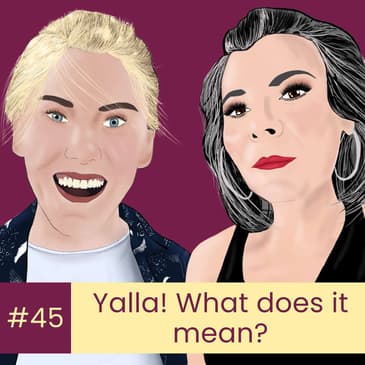
45. One word, endless meanings: Roula gives Rosie a crash course on "yalla" and why context is everything. From bedtime routines to moments of impatience, we break down how tone, culture, and emotion shape language. Plus, Roula shares how Dutch directness threw her for a loop—and why words like "prima" just don’t cut it.
Tune in and let us know: is there a word in your language that changes meaning depending on how you say it?
--------------------
- ☕️ Buy us a coffee!
- 🎙️ Send us a voice message
- 🛍️ Buy some Rosie and Roula merch!
--------------------
- ⭐️ Leave us a review
- ▶️ Follow us on Instagram and TikTok
- 🎞️ Subscribe to our YouTube channel
--------------------
- 🎧 Check out Roula's podcast
- 🎧 Check out Rosie's podcast
TRANSCRIPT
Rosie (00:00)
What do I feel like talking about? Okay, alright, alright, Alright, alright.
Roula (00:09)
Do
you want me to ask you the question and then you talk about it? Yeah.
Rosie (00:13)
No, I do not.
actually this would be one you talk about. Fine, okay,
ruler. We have known each other for a couple of years now and something you say a lot.
You can correct me. My pronunciation is probably going to be wrong. Is yalla. But I, I feel like this word has so many different meanings. It's just so nuanced. But I want to give us a crash course. Actually, no, give us some examples and I'm going to guess what it means in that context. So I'm putting you on the spot
Roula (01:03)
Yalla Rossi. Start recording.
Rosie (01:07)
Come on Rosie, let's go. Something like that. Yeah? It's close. my God. Seriously. my God. Something like that.
Roula (01:11)
Yalla! You're making me angry!
You really put me on the spot because I have it has the word has emotions and this is how the meaning change. Based on the emotion, the meaning will change. OK. Yalla yalla. We really have to get on with this.
Rosie (01:26)
Yeah. Yeah.
Yeah, yeah. Yeah.
gosh, like you're a bit stressed, like, come on, you're impatient.
Roula (01:45)
Yes, that's true, impatience. That's very, you know, this question is hilarious because sometimes my son before he goes to sleep, he wants me to do this entire Yallah thing over and over again because he notices too. Yeah.
Rosie (01:57)
What? What?
so what do you do? Are you
allowed to share it? What's this y'alla thing you do? Or is that, that's your ritual?
Roula (02:06)
Let's
comment it
Rosie (02:09)
Now is this what you do with Liam at bedtime though? No, what? Just like that? okay, okay, That's so good! I mean, Liam are connected. Okay, what was it again? Tell me the example. I was distracted.
Roula (02:11)
yeah, your question is what he asked me to do, yeah. To give him different examples.
I forgot, but I think I have another one now. Yellow. That's good. Yeah, yeah, yeah. There are a lot of...
Rosie (02:27)
Okay.
Okay. Fine. Okay. It's all, it's the intonation
and how you're saying it, I think. Yeah.
Roula (02:39)
I mean,
in Arabic language, there is Yalla and there's another word that is Khalas. And it really depends on the intonation. Khalas means stop annoying me. Khalas, Yalla, let's go. Let's go. Khalas, let's go. It means I'm fine. Let's go. Or we say Khalas, Khalas. It means no matter. It doesn't matter. It depends. It's how you say it.
Rosie (02:44)
Mm.
Okay.
Come on. Yeah.
Okay.
Mmm.
Roula (03:08)
and the body language and you know like, I do with my head like this.
Rosie (03:10)
Mmm.
Love you.
Roula (03:15)
And despite that I don't speak Arabic at home at all, I do use these words in between.
Rosie (03:22)
And I love that you do. You just started using it with me and I pick up on what you meant. There was no conversation of, this is what it means. You just get it.
Roula (03:33)
Yeah.
Rosie (03:34)
I love
that. I love it. And you feel comfortable to just do that, which is, I think it's awesome. Maybe I should start using it. That's true.
Roula (03:40)
Because it's you. I have to be comfortable. Indeed, indeed. I wouldn't
use it with new people. It has to be coming natural.
Rosie (03:46)
I'm in the inner circle, everybody.
Come a natural. Okay. I don't think there's a word like this in English.
Roula (03:52)
And so...
Rosie (03:55)
I didn't think so.
Roula (03:57)
In Dutch there are useless words but it's a word Prima
Rosie (04:00)
Yeah
Yeah.
What's that?
Roula (04:06)
Okay, so here's this is like a crash course language, culture, emotions. There are words used in Dutch that for me don't have a strong meaning. So they leave me confused. For example, if I say, if I ask you a question, I'm asking if you're okay with something, then you would say prima. Prima for me sounds like very neutral.
Rosie (04:09)
Okay, okay, yes. Yes.
Mmm.
Mm-hmm.
Roula (04:34)
I don't know, are you okay? Is this good or is this bad? Am I... It doesn't show truly how you feel about it. Prima, how are you today? Prima, but what does Prima means? I want to hear I'm good or I'm not good.
Rosie (04:37)
Mmm.
There's no motion in it. Yeah. Yeah.
Is it just like, fine, I'm fine.
Roula (04:54)
It's even less than that for me as coming from a different culture. And these are the things that my husband and I, sometimes we do have this moment of misunderstanding because some words don't mean anything to me when they're used. Yeah. And some words I use are too strong for him.
Rosie (04:54)
Not quite. Less than that.
Yeah, yeah.
Yeah.
Yeah, because he's Dutch, yeah? Yeah, yeah.
Yeah, yeah. Does it cause arguments sometimes?
Roula (05:24)
Bye.
Look at you, how happy. Yeah, it's cause I recommend sometimes.
Rosie (05:28)
Yeah, it's exciting. Well,
it's not communication and language is already complicated when you're speaking the same language as in it's your first language, but then you throw in like what's Dutch your second, third, fourth language. don't know. Like it's not your first language. Even though you're fluent now at it. Yeah, true, true.
Roula (05:46)
Now it is, in a way.
Rosie (05:50)
It's just fascinating to me because I, from my personal experience, arguments start because there's misunderstanding in words. You're speaking the same language, but somehow it means something entirely different.
So that fascinates me.
Roula (06:06)
Very much true, very much
true. I think communication, communication disagreement in same language has also more to do with the tone, the way the things are said, more than the word and the words are chosen, of course. You know, this is like my episode on my podcast, the words we choose. This is when we speak same language. My brain works in different languages.
Rosie (06:16)
Yeah. Yeah.
Actual words. Mmm. So fascinating.
Yeah.
Mm.
Roula (06:36)
And when you say something to me, mostly in Dutch, because English, feel it's clearer than Dutch, Dutch can be sometimes the words are so difficult to discern what they really mean. And I truly feel I'm lost in translation.
Rosie (06:43)
Interesting.
Mm.
Wow. Wow.
Roula (06:56)
Sometimes I receive WhatsApp in Dutch and there are moments I go to my husband to double check with him. Do I understand it correctly or not?
Rosie (07:07)
Wow.
Yeah. Wow.
Roula (07:10)
Because despite that the Dutch people think they're direct, they are not clear on what they're saying. They confuse directness, you know what I mean, when someone is direct, with clear communication.
Rosie (07:13)
Mm.
Give me an example, direct versus clear. I need an example of this.
Roula (07:34)
I can't think of an example. I can't. That's a one. No, I'm not.
Rosie (07:37)
you making it up. Okay, okay.
like is it the way it's delivered? I'm being direct, I'm confident in what I'm saying but actually it's not very clear, you're just being confusing, it's very vague.
Roula (07:52)
No, no, I'm gonna take you back to speak the same languages. Direct? People confuse direct with rudeness.
Rosie (07:59)
Yes. Yeah.
Roula (08:00)
Right?
But directness is being kind and clear.
Rosie (08:05)
getting to the point.
Roula (08:07)
And this is what I learned in living in the Netherlands, because in the culture I grew up in in Lebanon, people would, how do you say it, go around the bush and never tell you something straight.
Rosie (08:10)
Okay.
Yeah, yeah, yeah, beat around the bush.
Roula (08:22)
And that leaves you hanging. Are you coming or not coming on Saturday? It's unclear. And then in the Dutch culture, in the beginning, I noticed that this is rude. This is not direct. It's rude. When people would be like, it came, yeah.
Rosie (08:24)
Mmm. Yeah.
Yeah, wow. You came across as rude in their eyes.
Roula (08:46)
Yes,
Rosie (08:46)
Yeah.
Roula (08:47)
and then of course I became to understand the language more and then I could understand that these words are direct, they're not necessarily rude but I wouldn't use them because they don't open any door of communication, they're closed.
Rosie (08:51)
Mm.
Right.
Hmm. Comes back to etiquette really. You did. That was like, okay, let's wrap it up.
Roula (09:07)
Yalla, did I give you some answer?
And comes back to so many things, to vulnerability, to wanting to be clear, to kindness. Yeah, to having conversation, you have to read people.
Rosie (09:28)
Hmm. Hmm. I got no idea. You think we should wrap it up? Get to the point. You're not being very clear, ruler. You're being direct, but not clear. You're so Dutch.
Roula (09:30)
Where is this going? I don't know. I think we should wrap it up. No, I'm being Dutch.
Rosie (09:44)
Alright, I should say, yella, let's go.
Roula (09:46)
Yes. Okay. Thank.
Rosie (09:51)
catch you next time.
Roula (10:00)
Okay, now we're being silly. Stop it.
you